
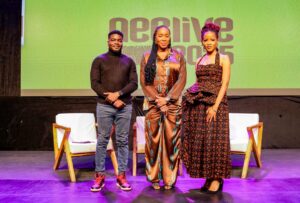
 L–R: Fisayo Fosudo, Visual Storyteller and Tech Video Producer; Tolulope Adeleru-Balogun, Head of Programmes at News Central TV; and Iretomiwa Akintunde-Johnson, West Africa Regional Manager, BHM Holdings, after the “Innovation & Creativity in the Age of Artificial Intelligence” fireside at the NECLive 2025, held at Landmark Event Centre, Lagos, recently
Iretomiwa Akintunde-Johnson, Regional Manager, West Africa, at BHM Holdings, urged African creatives and tech leaders to adopt AI strategically while integrating African values into technological solutions. The session at the Nigerian Entertainment Conference (NECLive 2025) explored how AI is disrupting creative industries, including music, film, design, fashion, literature, and comedy, and the implications for Africa’s cultural economies.
During the breakout session titled “Innovation and Creativity in the Age of Artificial Intelligence,” Akintunde-Johnson stressed that Africa must not lose its human-centred approach to creativity as AI grows, explaining that the continent often takes a tactical, not strategic, approach to AI, and adopts foreign systems “without adding African nuances.” She noted that AI “doesn’t understand Yoruba, it doesn’t understand an Ekiti farmer’s realities. Yet, no one understands the pain point of farming in Nigeria more than these farmers. They need access to AI to enable them to solve the issues better than any foreigner can.”
She noted that Africa’s traditional values are reflected in the frameworks highlighted in BHM’s white paper, titled “AI Ethics in Africa’s Media and Communications Landscape: A Readiness Framework for 2026 and Beyond.”
She explained that the frameworks, the Omoluabi and AWARE models, should guide how creators, companies, and governments approach and use AI on the continent.
 Iretomiwa Akintunde-Johnson, West Africa Regional Manager, BHM Holdings, speaking during NECLive
During the session, she discussed BHM’s Omoluabi-AWARE framework in its white paper, “AI Ethics in Africa’s Media and Communications Landscape,” designed to help individuals and organisations assess AI tools critically, mitigate misinformation, and align technology with African values.
Akintunde-Johnson also highlighted the need to empower grassroots users, noting that solutions for local challenges, such as agriculture, must be accessible to those directly affected.
“Right now, the people enjoying the benefits of AI are the very educated; the ones who have it on their phones and know how to use it. But think of a farmer in Kigali or a farmer in Kwara State who is struggling with his crops. The real solution he needs is not coming from a lab in San Francisco or even a lab in Lagos. It will only work if AI becomes accessible in his own language and in a way that lets him explain the problems he understands better than any educated 24-year-old graduate trying to build solutions for Africa.”
The first recommendation in the roadmap speaks to the foundation phase for policy development and education, because it’s important. The solutions we are looking for are here, not outside. But if we do not start creating policies in such a way that governments are infusing AI ethically into how they operate down to the grassroots level, then we will not move forward. The second is the implementation for deploying the pilot programme, and the third is the maturation phase for full-scale rollout and establishing Africa as a leader in ethical AI,” she said.
The session, moderated by Tolulope Adeleru-Balogun, Director of Programmes at News Central, also featured panellist Fisayo Fosudo, Digital Creator, who joined discussions on how AI is reshaping Africa’s creative industries.